TLDR: Upgrading car audio doesn’t always require removing factory components. Many systems can be improved by working with existing amplifiers rather than replacing them outright. Understanding how your system is designed helps you avoid unnecessary costs and achieve better sound results.
Key Takeaways:
- Factory amplifiers can often be retained and integrated with aftermarket upgrades
- Matching components correctly prevents distortion, damage, and poor performance
- Proper interfaces and signal handling are key to maintaining features and sound quality
- Planning upgrades based on goals leads to better results than replacing everything at once
Upgrading a car audio system can seem straightforward until you realise there’s already a factory amplifier tucked away somewhere in the vehicle. Many people assume it has to be removed before adding any aftermarket gear, but that’s not always the case.
A factory amplifier can add complexity but isn’t always a problem. It can often be kept and integrated with new components. The right approach depends on the system and your goals, so understanding it helps avoid wasting money and poor results.
Smarter Factory-Amplified Upgrades
In stereos, the head unit powers speakers directly, while amplified systems send signals to amplifiers that handle volume, tuning, and alerts. Some vehicles use digital signals, so standard wiring may not work.
Because of this, it is important to assess the system before replacing components. A thorough evaluation of system components ensures compatibility, avoids unexpected conflicts, and reduces the risk of costly installation issues later.
Your Factory Amp Does More
Factory amplifiers handle tuning, crossovers, alerts, and more, so removing them without checking can cause issues. Assess the signal type, channels and system dependencies to decide whether to keep, interface or bypass the amp.
Before making changes, consult wiring diagrams and test outputs to confirm compatibility with aftermarket components. If unsure, use integration modules or seek professional installation to preserve critical features like chimes, steering controls, and factory equalization settings.
Keep Your Factory Amp?
In many vehicles, an aftermarket head unit can work with the factory amplifier using the right interface and signal levels. The factory amplifier may need specific inputs or signals, which a suitable interface can provide while preserving key features.
Not all wiring solutions are equal; some may power the unit but fail to activate the amplifier or retain features like steering controls or cameras. Just because a head unit fits the dashboard doesn’t mean it will integrate properly with the vehicle’s electronics.
Impedance Mismatch Kills Sound
Speaker upgrades are common, but factory amps use unusual impedance, risking reduced volume or strain. Incorrect impedance or low-sensitivity speakers can overwork factory amps, causing distortion, overheating, or protection mode.
Better Speakers Don’t Mean Better Sound
Factory amps are tuned for stock speakers, so aftermarket speakers can sound harsh or unbalanced with the same signal. This doesn’t mean the speakers are low quality, just that the signal may need adjustment.
Boost Your Factory Sound
A subwoofer can be added without replacing factory audio by tapping signals and providing turn-on. In simple setups, use speaker-level feeds into high-level inputs or converters; complex systems may need channel summing for full-range signals.
Watch for Factory Bass Roll-Off
Some factory systems cut bass as volume rises to protect speakers, so an aftermarket sub may sound strong at low levels but weaken when turned up. Advanced LOCs and DSPs can fix this, while basic converters often can’t, so a simple rear speaker tap isn’t enough.
What Line Output Converters Does
A line output converter of speaker-level signals into low-level signals for aftermarket amplifiers, with basic and active models offering cleaner output. Basic converters work for simple setups, while active models offer cleaner output, signal sensing, and bass correction.
Vehicles with digital networks or complex audio systems may need specialized interfaces or signal processors instead. Selecting the appropriate solution depends on system complexity, integration requirements, and the level of audio performance you ultimately want overall.
When to Keep the Factory Amp
Keeping the original amplifier makes sense when it works properly, and the upgrade is modest. It helps reduce costs, preserve factory features, and avoid extra wiring while still delivering noticeable improvements in overall sound quality.
However, compatibility and power limitations should be considered before relying on the stock unit for new speakers. If distortion appears at volumes or features are lacking, upgrading the amplifier can unlock clarity, control, and headroom.
When to Bypass the Factory Amp
Bypassing the factory amplifier makes sense when it can’t drive your speakers well, adds heavy EQ, or limits performance. Keeping amp is possible, but rerouting audio and speakers needs new wiring and proper power.
Upgrading your system can significantly improve clarity, volume, and overall listening experience when done correctly. Careful planning ensures compatibility between components and avoids potential issues with wiring, power distribution, and signal quality.
Audio Changes the Rules
Some vehicles use fibre-optic or digital networks like MOST, so no analogue signal exists, and a digital interface is required. Universal wiring rarely suits modern vehicles with complex amplified systems, and models present upgrade challenges.
Test Before & After Installation
Test all sound functions before and after installation to ensure proper operation.
- Verify speakers, calls, and navigation pre/post
- Verify steering controls and chimes pre/post
- Verify parking tones and camera alerts pre/post
- Verify balance and fade pre/post
- Verify menus and system responses pre/post
- Confirm overall audio and alerts pre/post
Upgrade Mistakes to Avoid
Many problems start before installation, like mismatched components, incompatible head units, or improper wiring that causes noise, distortion, or failure. These issues often stem from a lack of planning and understanding of how each part works together.
Another common mistake is replacing too much at once without a clear goal, when targeted upgrades based on desired results are often more effective. The smartest approach starts with defining the outcome, not the shopping list.
Before You Buy Aftermarket Gear
Note your vehicle’s make, model, year, and factory audio setup, then define goals like better clarity, stronger bass, higher volume, or smartphone integration. Then consider amplifier location, signal type, speaker impedance, controls, space, future upgrades, and budget overall.
Retain, Integrate or Bypass
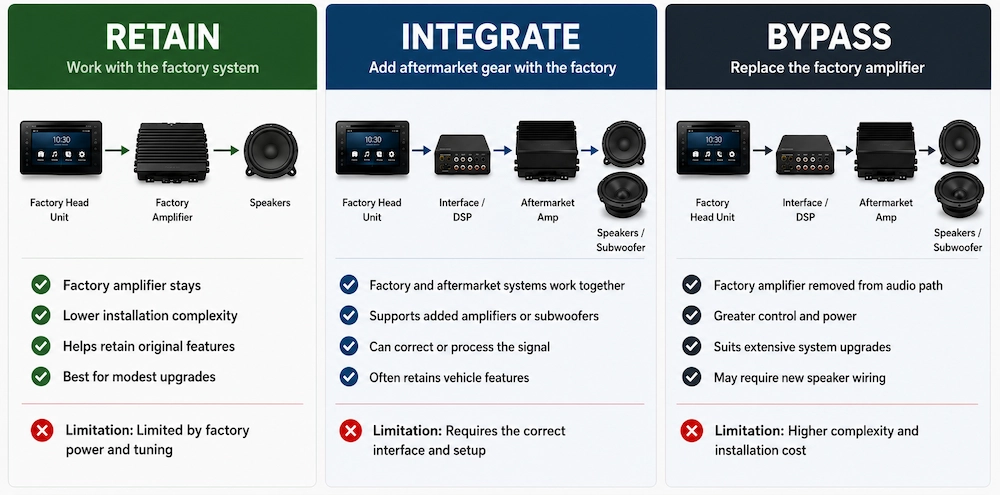
Retain
The factory amplifier stays in control, and compatible aftermarket parts are added around it. This suits lighter upgrades and systems that still perform reliably.
Integrate
Interfaces, converters or processors allow factory and aftermarket equipment to communicate correctly. This is often the best balance when important vehicle features remain operational.
Bypass
The factory amplifier is removed and replaced with aftermarket amplification for improved system performance overall. No approach is automatically superior, as the right choice depends on the vehicle, the existing system, and the desired result.
About Sydney Mobile Audio
Sydney Mobile Audio upgrades car audio systems across Sydney, including head units, speakers, subwoofers, amplifiers, and smartphone integration. Each installation is tailored to the vehicle, ensuring clean wiring and alignment with the customer’s goals rather than a generic setup.
The team evaluates whether to retain, integrate, or bypass existing amplifiers before recommending a practical solution. Their approach considers the vehicle, desired sound quality, and budget to deliver a balanced and effective system.
Plan Before You Buy
A factory amplifier doesn’t have to limit your sound; understanding it first allows smarter upgrades and preserves essential features overall. With the right approach, you can unlock better performance without sacrificing features you rely on.
Contact Sydney Mobile Audio today!